Friday, June 17, 2011
The Chappati Heartache
############################################
The Chappati Heartache
############################################
The soul of Indian food is composed of rotis. These complex carbohydrates form the staple food of a billion people worldwide. They are delicious to eat and highly nourishing for the body (proteins and fiber). So naturally, they are a delightful pain to make. The procedure is messy, time consuming, exhausting and at the end of it all, you are just glad there is something to eat! I would attribute getting consistent (good) chappati results over and over again to a stroke of pure luck. At every attempt at chappati making, you get closer to getting better. Which only means that you will never be perfect, just like an infinite series only promises to converge at infinity. Are you willing to wait till eternity to eat perfect chappatis made by you?
If you don't believe me, allow me to exemplify my theory with -- myself! I am your average girl next door, have been away from home for several years, eating copious amounts of rice and pasta during those years and close to being sick of rice and any form of beans. I greatly enjoy (and sorely miss) my mother's cooking. I have been trying to make chappatis for a while now but the art of chappati-making completely eludes me! Sure, every once in a while, I have the blessing to enjoy my own handmade steamy, puffy, soft, melt-in-my-mouth chappatis, but the sheer amount of times I have had to eat thick, hard, chewy chappatis just ruins the pleasure. It's like my chappatis are forever jinxed by a cosmic conspiracy. How else would you explain that in say, x number of times I have made chappatis, 10x! uniquely different things have gone wrong? Now, do I see some heads nodding in agreement? Haven't we all been there, ladies (and um... the real gentlemen)? Hence the chappati heartache -- consistency is the key in chappati making, but the lock is unfortunately password protected.
Don't get me wrong. I love the entire cooking process, but failure frustrates me. Repeated failure prompts me to write about it. It is my belief that cooking results directly indicate the mood and frustration level of the chef. I have noticed that if I am frustrated about something (other than cooking), my chappatis come out great. This I believe is because, frustration is good for the dough-making process, you have all the motivation to beat the crap out of it and the dough comes out soft and smooth. Ironically, if I am frustrated about how my chappatis are turning out, their quality just goes downhill from there.
For the benefit of the naive beginners and the entertainment of the (self-proclaimed) chappati experts, allow me to explain the nuances of the fine art of chappati-making. It is hoped that in spite of some not-so-subtle sarcastic (frustrated) statements, this will be considered a useful guide.
The chappati making process has 4 main steps:
Kneading the dough
Making small balls of the dough
Rolling out chappatis
Roasting the chappatis
It is difficult to judge which one of the above steps is the most idiot proof, because like I mentioned, I have goofed up every step of the way, and still discovering new goofs and mutations of old ones.
Step 1: Kneading the dough
This process is a little messy. Beginners, please remember to clip your nails and wash hands with soap and water! Use a nice broad mouthed vessel for this process, one that would have room for various violent arm movements.
Start with some atta (wheat flour) in the vessel, and add salt to it.
Then add 1 teaspoon of oil and rub into the mixture.
Now gradually add water, rub into the mixture. Continue adding water until the mixture looks like dry scrambled eggs.
Now sprinkle about a fistful (?) of water and combine into a single dough structure.
Knead and knead, till your knuckles give out, and your carpal tunneled wrists are permanently hanging at right angles to your arm.
Wash hands and cover and keep dough aside for at least 10 minutes.
Tips on kneading dough
Start making the dough when you are frustrated. Imagine the dough as the object of your frustration and vent it out. Start at the end of the long school/ workday for the ideal frustration level.
Salt is an important and easy-to-forget ingredient!
Keep in mind, the physics theories of relativity and the uncertainty principle.
Why? If you made nearly perfect dough today, measured the amount of ingredients with astronomical precision and the next day mixed up the exact astronomical amount to make the dough, the result will almost always never be perfect. According to my research, this is due to the fact that your experiments can be affected by the plethora of factors, your sense of measurement, instruments used, number of experimental trials, temperature, humidity, sweat level of the palms, magnitude and direction of the force vectors applied to the dough, quality of the mill that ground the flour, entropy of the atmosphere, pollen count etc., to name a few. In the big picture, all this boils down to the following factors: the speed of light, the speed of kneading relative to the speed of light, the orientation of the earth, its rotational speed and the resulting centripetal force and the gravitational pull of other celestial objects to name a few of them. That is how physics becomes involved. As you will soon realize, it is difficult for an uninformed mind to keep all these factors in mind. For a more detailed guide for this step, please refer to another guide that will be written after the completion of research: “No Two Dough Balls Are The Same – Why?”
Rare second chance opportunity, If dough turns out too dry/hard, try adding water and knead extra hard to incorporate in the dough.
If dough turns out too soft/sticky, You have messed up. You can try adding more dry flour and knead till you pass out, but I doubt if the situation is recoverable.
A word of confidence: Whatever the end doughy result is, try to continue with the following steps, because after all, you can always eat thick, ugly chappatis.
Step 2: Making balls from the dough
1. Break the dough into 'ping-pong size' balls, smooth, no cracks or gradations on the surface. Opinions vary among the chappati gurus, some say 'marble sized', some say 'lemon sized' and some others say 'small melon' sized. My short stint of experience seems to suggest that 1.45” would be more or less the precise diameter.
This sounds a little too easy but believe you me, if you mess up here this could jeopardize the next steps.
Step 3: Rolling out chappatis
Keep dry flour handy for dusting purposes (a little more if your dough is on the sticky side)
Take each ball from the previous step, flatten on the rolling board, apply flour and roll with the rolling pin. In the beginning, the rolling process would seem more like flattening. But this is a delicate process; one has got to respect the chappati.
Roll out into rounds of about 6-7 inches in diameter. And that's it!
Tips, Tricks and Strategies for rolling
You have to talk to the chappati, sometimes curse at it. Show who the boss is. At the same time, be gentle. Just like teaching a kid how to tie his/her shoelaces (except for the cursing part).
The trick is to roll such that the chappati rotates with your motions, so that it is even throughout.
A neat little trick that my mom once taught me: Once the chappatis are about 1 inch in diameter, roll with even pressure (not measurements again), trying to roll out the edges to prevent overworking the center.
If you worry too much about the shape, it will never come out round.
Remember that you cannot get the round shape by tricky rolling pin movements in the end. That is why step 2 is so important; you have to make the balls such that if you flatten it, it is a perfect round. Now rotate it and roll evenly to try and maintain that as far as possible.
Step 4: Roasting the chappati
Preheat the tawa/griddle.
Wait till small bubbles are formed and the surface facing the tawa has small brown spots.
Use a paper towel or clean kitchen cloth and apply pressure on the chappati to cook it from within.
Remove and apply ghee to the surface that has just left the tawa. As a wise man once said, “It is very important to realize that in the real world, everything has a right side and a wrong side.” Truer words have never been spoken.
If you followed all the above steps 100% correctly, there is about 50% probability that the chappati will puff up nicely. Tips and Tricks for roasting
Keep your eyes peeled at the chappatis; they love to burn.
When in doubt, turn the chappati over to check for doneness. If it is not done, flip it back. Defense is the best strategy you can use here.
Keep the flame on 'high' while cooking the chappatis. This is supposed to prevent them from becoming hard on cooling.
Now that the process is outlined, do you feel you are up to it yet? Here is the final twister that adds slight complications – multiplexing.
Yes, you are expected to perform the rolling, toasting and greasing processes in a parallel, pipelined fashion for optimum time and fuel efficiency. By the time you lovingly roll out the chappati at hand into a semi-circle with Australia on top, the one on the tawa has turned to coal and the ones piled up waiting to be greased have turned to stone.
As with most things in life, one should start with this adventure simple and add the multiplexing to give themselves a challenge along the way. Unfortunately, such people are considered lowly novices among the chappati elites.
I can almost see those chappati experts rolling their eyes saying, well, Rome wasn't built in a day! My answer to them would be, of course that makes sense, Romans were so preoccupied with making pizza dough that they procrastinated building Rome!
They say perseverance pays and practice makes perfect (or nearly perfect in this case). In the meantime, misery loves company, so I am sharing my whines and complaints. Then again, a new day will come and I will go through the process once more, and maybe one day I will be close to getting better at it. Remember, he who says he is perfect, lies. She, who says she is perfect, usually lies.
####################################################################
Monday, March 14, 2011
Spicy Granola aka Bhel Puri
- The tiny, round, puffy, crisp semolina puris that are stuffed with warm boiled potatoes and silky legumes, then filled with a cold, minty, spicy and tangy, green liquid. Once filled with the liquid you move really quickly and put the puri as a whole into a wide open mouth. As your teeth sink into it, there is a gush of warm meeting the cold. The crisp meeting the soft. The spicy and tangy meeting a very satisfied palate. A complete balanced meal if you asked me! This is called the Pani Puri -- and undoubtedly my favorite in the chaat family. One day, I will tell you more about the experience if you have never had the good fortune of enjoying this at an Indian street corner.
- Then there is the Pav bhaji. A spicy medley of vegetables - potatoes, cauliflower, green peppers etc, simmered in a tomato based sauce with a special blend of spices. This is served with a slab of butter melting on top with a side of pillows of soft bread rolls toasted slightly on a hot griddle. Here is a picture of a the street side chef cooking up a batch of Pav Bhaji, taken during a recent trip to Mumbai.
- Next, there is the Ragda Pattice. A layered dish of crisp potato cutlets, with a generous helping of spicy chickpea/white pigeon pea curry (similar your usual chana masala from the neighborhood Indian restaurant), topped with condiments such as spicy mint and tangy tamarind chutneys, chopped raw onions and crispy fried chickpea flour noodles. The aroma of the cutlets frying up on the extra large griddle is not easily resisted. Neither can you miss the metallic din of the stainless spatula used to flip and cook the Pattice or cutlet on the cast iron griddle the size of Texas.
- Vada Pavs are to Mumbai what Hot Dogs are to New York City. The original veggie burger, simply dressed in fresh out the frying pan warmth. A spicy mixture of mashed potatoes with onions, garlic and spices are formed to round balls. They are then dipped in a thick chick pea batter and fried to crispy goodness to form the vada. Then, the softest imaginable dinner rolls called Pav are split and slathered with a red chili garlic powder. The beloved vada is held between two halves of the Pav. The whole snack is only palm sized, and is devoured in only a few bites but packs a devastating punch in flavor. No need for any other fancy toppings, or dipping sauces, this is the on the go snack for the city that truly never sleeps. Just watching the efficient supply chain management of one of the vada pav vendors can easily form a case study lesson for business schools. Not Kidding!
- The most popular and easily portable snack among the masses is undoubtedly the bhel puri. You could think of it as the Indian trail mix. It is a mixture of churmura or puffed rice, sev or crispy fried noodles, papdi or flat fried chick pea disks and mungfalli or peanuts, roasted together with seasonings and spices. Just before serving, this is folded in with mint and tamarind chutneys, minced vegetables onions, tomatoes, boiled potatoes green chili (yes, ofcourse it counts as a vegetable!).
Bhel Puri Mix | |
2 tsps vegetable oil | Heat the oil in a pan. Add the mustard seeds, once they pop, add the remaining ingredients and fry for a 30 secs or so. |
2 cups Kashi 7 Grain Puffed cereal | Add the puffed cereal, peanuts and the pita chips and roast till the mixture is crispy |
Once cooled, store this mixture in a airtight container. Just snack as is or make into bhel puri.
Bhel Puri | |
1 cup of bhel mix | Toss together all the ingredients on the left! |
Thats it. A healthier, unorthodox way of enjoying Bhel Puri. Not the same as the street side counterpart, but a close nostalgic fusion.
Sunday, July 18, 2010
Whats that smell?
The trouble is that Indian food smells extremely inviting when it is fresh and hot and oh so delicious. There have been many days in my years of apartment living when I felt instantly homesick having woken up to the smell of ‘khichdi’ or ‘paratha’ or ‘rasam’ from the kitchens of my many Indian neighbors, dispersing through the long carpet lined corridors in the building. That same night as I would return home, I would be instantly nauseated by the weakened, yet prominent elements of the same morning smells in the corridors. Like the smell of cooked basmati rice. Or cooked lentils. It is never the freshly ground spices you smell at this time long after the food has been cooked and perhaps even eaten. Those volatile pleasant odors just disperse into thin air. What you smell are the persistent remains of background ingredients that penetrate through everything. You skin, your clothes, your hair. No amount of perfume or cologne in the world can help you. The only solution is a nice long soak in the bath, good amount of scrubbing and some rinsing with scalding hot water. Lather, rinse, and then repeat. Do that for yourself then for your entire closet.
Now it is my personal belief that the smell is mainly due to the type of oil used and type of degeneration it goes through at the temperatures it is heated to. Olive oil can stink up a whole neighborhood if heated high enough to make a proper Indian ‘tadka’. You need a good heat friendly vegetable oil or sunflower oil for that. Even then there is a chance you will be walking around smelling like ‘dal’ depending tadka ingredients and how long you let them brown. About 65% of all Indian food calls for frying in hot oil – and invariably the oil gets beaten and battered at high temperatures and the aromas of the oil fumes just envelope and eventually overpower your natural scent.
So, am I saying avoid Indian food? No, absolutely not. The best thing you can do to your palate is to experience the flavors of Indian cuisine. Ask any Indian worth his/her dhoti/dupatta – they will tell you that when it comes to combating the strong, complex aromas of Indian cooking, prevention is better than cure. I assure that like my husband, there are many of them out there have tried to study the wind patterns in their poorly ventilated North American kitchens. Many a ‘gadgets’ have been invented to direct the air from the kitchen out through the closest windows. We used to have a dedicated fan near the kitchen that had to be turned on high speed and angled just right to sweep the cooking air out through the back door. This was in addition to a loud vacuum inducing exhaust over the stove. I no longer mind that the exhaust drowns the sound of the TV or music playing in the background.
Allow me to offer some wisdom on dampening the possible effects of Indian cooking on your home atmospheric air. Before entering the kitchen to begin prepping for cooking, be sure to close all other doors to all rooms in the house, including closet doors. Make sure you are not wearing your ‘going out’ clothes, because you are going to have to put everything you are wearing for wash as soon as the cooking is done. Put away any odor sensitive items such as blankets, sweaters, coats etc behind closed doors. Open up windows on two opposing walls if available, to induce some healthy cross ventilation in the kitchen and attached living areas. You want to leave the air only one place to go – out the open windows. Remember warm air rises like a cloud. So a cold breeze from a fan or AC vent near the heat source can greatly improve circulation. A good quality over-the-stove exhaust is absolutely essential – be sure it is on before your stove turns on. Proceed to enjoying the cooking process at your leisurely pace now. Keep the exhaust fan going for atleast 30 minutes after the cooking is done. With these precautions alone you can minimize damage area. Don’t wait too long before cleaning up the kitchen after all the cooking. Store your leftovers in airtight containers in the coolest part of your refrigerator (top shelf closest to the freezer). Now you may light up some fragrant candles or oils until you get your house back.
Say you forgot to take some of the precautionary measures and your house now smells like last night’s dinner. Allow me to impress upon you the fact that I told you so. But I will also offer some possible solutions. Close all the windows, and turn up the heat in your house to a level above the outside ambient temperature. I know you will get sweaty, but don’t be impatient. Now turn the heat off and open all doors and windows for about 15 minutes. The warmer inside air will escape out while you welcome the cooler fresher air in.
So while the popular stereotype about the exotic Indian food staying with you long after coming in contact with it may have some truth – hope by now I have helped you lose some of your fear of trying out the cuisine for yourself. As for the other myths and stereotypes like imaginary ingredients, namely ‘curry powder’, well, that’s a whole another topic for another day.
Thursday, September 03, 2009
Chaat it up! Restaurant Review
We drove into Bramdesh, as the localites lovingly refer to Brampton -- and into this hidden jewel somewhere outside of town
Mirch Masala
8917 The Gore Rd,
Brampton, ON
We pulled into the sprawling strip mall aptly titled Jaipur Gore Mall, lined with Indian businesses -- a Hindu temple, a Hindu Montessori school, Subzi Mandi cash and carry, Chilli Szhezuan Indian Chinese restaurant etc. Snug n the middle was 'Mirch Masala' standing out with its bright yellow sign and the attractive posters boasting of the sheer variety in the menu. "21 Paratha varieties", "51 eggless cake flavors", "100 % Vegetarian". We walk in -- and we are the only ones there! Maybe we were the only chaat crazy ones on a late Sunday afternoon. Well -- no time is better for chaat than right now if anyone cared for my humble opinion.
On glance at the menu and you know you are out for a smogarsboard. Why can't you have yourself a Pani Puri, a Bhel Puri, Dahi Puri, Aaloo tiki chaat and Papdi chaat when you have it all for less than CAD 5.00 a piece? Once you are down with the light stuff, head over to the 11 different varieties of vegetarian burgers. Are you reading this McDonalds? Now that is what I call a happy meal. Try a 'samosa'wich burger -- a burger packed with samosa pieces and spicy chickpea curry, topped with onion, tomato and lettuce. Add chilies to your burger, kick back your shoes and sink in. Samosa does not fancy you today? No problem, try a Indian curry burger or a Bollywood burger or a Greek Burger. Make it a combo and add Masala fries and a soda.
Ok, you really wanted to go to Brars but your chaat crazy wife guilted you into coming to Mirch Masala? Don't worry, you will not be missing out on anything. Have a Paneer Tikka platter - includes grilled paneer tikka, with grilled peppers, tomatoes and onions. With a side of chickpea curry, butter nan and rice for CAD 8.99.
And end the meal with hot gulab jamuns. Wash it all off with a fresh lime soda or masala chai.
Sriracha hot sauce flows free as the Niagara Falls. Goodbye bland food!
Next time you are in the area, stop by at Mirch Masala and enjoy a quick meal. The menu is sure to please all kinds of taste buds. If any locals are reading this -- please enlighten me -- why wasn't the place swarming with people, a place like this deserves dedicated patronage :) Is there a better chaat place I should try?
Tuesday, August 11, 2009
Dinner Dance
You may graduate from college in four years, but graduating from the college lifestyle can take longer. I have trouble getting up for those early meetings. I am forever running 10 minutes late for everything. Dinner is something I get in the stomach, not necessarily on the table. While I am growing out of these habits slowly and steadily, there are crazy days that I absolutely need to conjure dinner in less than 10 minutes. Most often this is because I am absolutely dying of hunger at the end of the day. I call this my weekday dinner dance. Today being an exemplary day of swooning to the rumblings beats of hunger, I turned the stove on, rummaged for my favorite pan, drizzled a few drops of oil it and placed the pan on the stove. Then I tapped off my shoes and washed my hands. From the freezer, I picked out some veggies – chopped mixed peppers, broccoli or cauliflower, threw in a handful of them in the hot pan added some seasoning. As the veggies rocked and rolled on the stove, I morphed into my pyjamas and washed up. I ran a knife through whatever combination of fresh aromatics I had on hand – onions, garlic, cilantro, and chili peppers and dropped them into the party. Thinly sliced tofu and aimed them into to the pan with seasonings of salt and pepper. The tofu and vegetables browned as I checked out the day’s mail and separated the bills from the junk. Two huge fistfuls of dry thin rice noodles went to the pan, with a cup of water. Now I did some on the spot walking as I patiently let the noodles cook up and the water get absorbed or evaporated. Noodles were transferred to a plastic container and eaten right out of the container. The leftovers were left over in the same container for the next meal which may be the next day’s lunch.
Such is the joy of cooking that satisfies your basic human needs.
Tuesday, August 01, 2006
What I have learnt from MIL
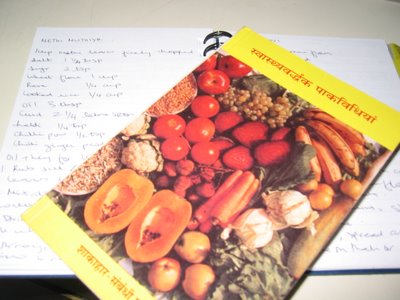
MIL too is an ardent cook ... she loves to cook not just for herself, but for sharing with everyone. And I have mentioned elsewhere in this blog that she enjoys food discussion and description! So, needless to say, I got to learn a lot many new recipes with her around. Infact she brought with her a cookbook in Hindi which I greedily grabbed. It has been such a long time (10 years to be specific) since I have properly read any form of Hindi. I used to be prolific reader of the language during my school days. Now, I will get a chance to rebuild my Hindi skills along with healthy cooking ideas. The book is titled (Translated for every one's benefit) - Health Reviving Dishes - Vegetarian Related. I also have a fresh supply of family recipes, which ofcourse I will try to share with you all in due course :)
Some other important cooking lessons that MIL has imparted on me
- Reduce Wastage - This one is a biggie. In my daily rush to get done with dinner, I usually throw in what I find in the fridge. No proper planning into whats been there for how long or how leftovers can be used. With MIL here for these past months, I just cannot remember throwing out any edible item just because it went bad before it could be used. She had a plan of what to do with a vegetable or produce item when we bought it at the store. Also left overs were planned for accordingly. For example, today's leftover dal or cooked rice would be made into muthiya's for the next day's breakfast. Wastage also was not only in food items - I tend to be prolific in my use of plastic ziploc bags, paper towels etc. Since my habit is an easier and quicker option, it might be difficult to change. But I will certainly be concious about other alternatives before I lunge to grab another bag or paper towel :)
- Importance of Breakfast - This is something I knew all along... that a good breakfast is a great start to the day. But, somehow never incorporated it in my lifestyle. Cooking up a hot breakfast means adding planning time, cooking time and extra washing time to the morning drill. So, I have usually avoided it in the past. When MIL was here, she would make it a point that we didn't leave without a hearty breakfast. She would make us hot jowar/bajra rotis. Just one at 8 in the morning would fill me up good until 12 or 1 in the afternoon. We have gone back to our cold cereal routine for now, but maybe I can practice speed-breakfast skills on weekends.
Thursday, June 08, 2006
These are a few of my favorite things
10 things I miss of Mom's cooking
Try as I might, I can never enjoy my own cooking. It has been cruelly long since I've had any of mom's cooking and I thought I would salivate a little thinking of what I miss the most. Here is what I came up with...
10. Her many undocumented masterpieces... *clean up the fridge special*... with warm just ballooned chappatis. I miss the variety in taste and the incredible suspense in those meals. Oh.. the joy when we correctly guessed the secret ingredients :)
9. Badam Kheer (Almond milk pudding)
8. Fragrant Arachvitta Sambar (Sambar with freshly ground spices) with drumsticks
7. Alu Paratha
6. Rava Payasam (Semolina milk pudding)
5. Filter Coffee
4. Masala Dal Vada (deep fried, crunchy lentil fritters)
3. Lemon rasam, rice and crunchy roasted small potatoes and/or Vazhaka Podimas (Spicy Mashed Plantains)
2. Hot idlis, rubbed generously with Molaga Podi
1. Vatral Kuzhumbu with hot steaming rice, with creamy spinach kootu on the side
I am rumbly in the tummy with all that food talk.
I would love to hear what some of the readers consider their childhood indulgence!
UPDATE: Following the suggestions of some fellow bloggers, I have decided to make this into a Meme - 10 Things I Miss of Mom's Cooking. It doesn't have to be a food item, may be just a meal tradition etc. I hope you will enjoy writing it up! Here are the first few people (in no particular order) I am tagging.
1. Revathi
2. Aparna
3. Ashwini
4. Shammi
5. L.G.
6. Mika
7. BDSN
8. Sailu
Participation ofcourse will be entirely optional. Tag 3-5 people to continue the meme. Enjoy!